Don't Compare Your Podcast to "Diary of a CEO". Here's why
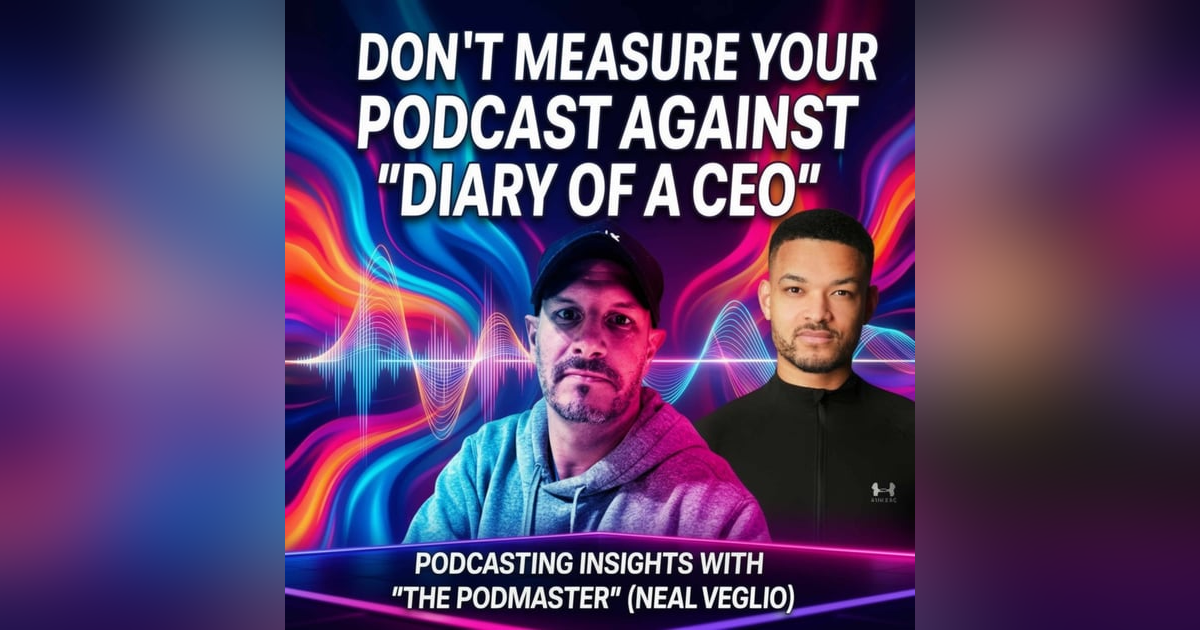


Diary of a CEO is doing something genuinely damaging to indie podcasters. Not maliciously. The damage is the business model.
Hi, I'm Neal Veglio, The Podmaster.
In this episode, I'm breaking down exactly why comparing your show to mega-podcasts like Diary of a CEO, High Performance Podcast, and Young and Profiting isn't just unhelpful — it's statistically irrational.
Using Phil Rosenzweig's Halo Effect, Nassim Taleb's Silent Graveyard, the Columbia Music Lab experiment, and Daniel Kahneman's narrative fallacy, I'll explain the intellectual architecture behind why these shows exist, who they're actually designed to serve, and why their 'success strategies' are largely retrospective fiction.
You'll hear why the gap between what these shows promise and what they can actually deliver is not a flaw — it's the product.
Also in this episode:
Listener email: Do you actually need a trailer episode before you launch?
Experiment: Listen back to your three most downloaded episodes and steal from yourself.
If you've been measuring your show against something that was never real — head to podmastery.co and click 'Get your podcasting challenge solved'.
Let's talk about Diary of a CEO Podcasting
Speaker:Insights.
Speaker:I want to talk about it because Diary of a CEO and the
Speaker:whole genre of glossy titan
Speaker:interviewing, formula peddling, mega
Speaker:podcast it represents is doing
Speaker:something genuinely damaging to indie podcasters
Speaker:right out in the open. No attempt to hide it whatsoever,
Speaker:possibly even to you. And the really interesting part
Speaker:here, the part that should probably keep you awake at night
Speaker:or at least mildly inconvenience your afternoon,
Speaker:is that it doesn't need to be malicious to be harmful.
Speaker:The damage isn't by accident. It's actually the business model.
Speaker:Let me explain Podcasting
Speaker:Insights.
Speaker:I've said it before and I'll keep saying it until people actually start to
Speaker:listen. People like Stephen Bartlett, Hala
Speaker:Taha and Alex Hormozi are goons.
Speaker:They're not evil goons. They're probably not even stupid
Speaker:goons. They're perceived to be
Speaker:successful goons who have figured out that the most profitable thing you
Speaker:can sell someone is isn't a solution. It's
Speaker:that feeling that a solution is just around the
Speaker:corner from you. But don't take my word for it. Let me
Speaker:give you some actual research. Because
Speaker:Neal thinks they're goons doesn't quite cut it as an
Speaker:intellectual foundation. Even I'm aware of that.
Speaker:Let me tell you about Phil Rosenzweig. Phil is a business school
Speaker:professor who spent years studying something very specific,
Speaker:and that was how we decide why successful companies
Speaker:succeeded. What he found and then documented in a book
Speaker:called the Halo Effect is almost offensively
Speaker:straightforward once you've heard it. When a company's doing
Speaker:well, we look at its leadership and we call it
Speaker:visionary. You know, the culture, the dynamic,
Speaker:the strategy all bold, but then
Speaker:the same company hits the skids. Same leadership,
Speaker:but now suddenly described as arrogant. Same culture
Speaker:now siloed and resistant to change. Same
Speaker:strategy is now reckless. And I could
Speaker:name particularly wet brand
Speaker:that this could definitely apply to. I
Speaker:wonder what brand leader I might be referring to.
Speaker:(Showbiz wink.) See, nothing's actually changed there.
Speaker:It's just the outcome is different. And we worked backwards from
Speaker:the outcome and constructed a story that made it feel
Speaker:inevitable. Sound familiar? Well, it should,
Speaker:because that's the entire editorial model of Diary of a CEO
Speaker:CEO. Guest comes in, sits down. Guest
Speaker:was successful. That is the rule. Guest explains
Speaker:why. Brain then assembles a coherent narrative from
Speaker:what was actually a chaotic contingent.
Speaker:Luck riddled mess. We all nod along and
Speaker:take notes. Steven Bartlett then charges
Speaker:advertisers a fortune to podcast the whole thing to an
Speaker:alleged millions of people. I say alleged
Speaker:because the data I've seen suggest it's still only in the hundreds of
Speaker:thousands range. Anyway, that's a debate for another episode.
Speaker:I think I may have even already published that one, by the way, a
Speaker:couple of years ago. If you want to peruse the library of past episodes
Speaker:back onto the point, let's talk about Nassim
Speaker:Taleb's Fooled by randomness now, if you haven't read,
Speaker:has a concept he calls the Silent graveyard.
Speaker:And I think about this basically every time I see another
Speaker:success porn podcast dropping into the business chart
Speaker:or being praised in my LinkedIn feed by some
Speaker:wannabe influencer. Bruh. Here's the idea.
Speaker:You look out of the world and you see winners.
Speaker:Founders who built things, podcasters who grew audiences.
Speaker:People who posted their frameworks and their 10 step
Speaker:systems and their morning routines
Speaker:and made it all the way to the point where they get to explain their
Speaker:morning routine on someone else's podcast. Yay.
Speaker:What you don't see as part of that whole parading
Speaker:of success is the graveyard. The
Speaker:equally talented, equally hardworking, equally routine
Speaker:having ass. People who tried the same things, moved
Speaker:the same levers, and failed anyway. They're getting
Speaker:up at 5am but they're not seeing
Speaker:stars. They're not on podcasts. They're not
Speaker:being booked on keynote stages. They're not selling you
Speaker:their 33 laws of attraction. They're just
Speaker:gone. And the graveyard is silent.
Speaker:Hence the name. So when Diary of a CEO books another
Speaker:guest to explain exactly how they got to where they are, and you're
Speaker:not getting a representative sample of what those strategies actually
Speaker:produce, you're getting a cherry picked survivor
Speaker:insisting the cherry picking didn't even happen. They
Speaker:earned their place, God darn it. And it gets better
Speaker:or worse, depending on your disposition around this whole thing.
Speaker:In 2006, researchers Matthew Salganik
Speaker:and Duncan Watts at Columbia ran an
Speaker:experiment that should frankly be shown to every podcaster
Speaker:before they're allowed to download a single
Speaker:episode of a success advice
Speaker:show. They built an artificial music market.
Speaker:14,000 participants, 48 songs, all
Speaker:by unknown bands. Participants could listen and
Speaker:download whatever they liked. Now, one group made their
Speaker:choices with absolutely no information about what anyone else had
Speaker:downloaded. Completely independent judgment.
Speaker:Kind of like the opposite of a Swifty. The other
Speaker:groups could see the download counts within their group.
Speaker:Now let me point out that if quality were the main
Speaker:driver of success here, the same songs would
Speaker:rise to the top across every single group
Speaker:consistently. Because they're
Speaker:objectively the best tracks. I mean, quality wins,
Speaker:right? Wrong
Speaker:embarrassingly wrong. The same song could
Speaker:be number one in one group and number 40 in
Speaker:another. Identical track, completely the same.
Speaker:The only difference was who happened to download it first.
Speaker:Early momentum created its own pull. And this
Speaker:translates to business. The rich get richer,
Speaker:not because they're better, but because they got a random early
Speaker:advantage and everyone else follows.
Speaker:So the next time you're trying to reverse engineer why a
Speaker:podcast got big, whether it's their interview
Speaker:technique, their niche, their consistency,
Speaker:their launch strategy, just remember
Speaker:you might be studying the podcast equivalent of which
Speaker:show someone clicked on first on a random Tuesday
Speaker:afternoon. Luck. Timing.
Speaker:Chance. Yes, quality's in the formula,
Speaker:but so is chance. Now here's the part of
Speaker:this that gets really fun. Even the people giving
Speaker:you that misleading information probably aren't lying.
Speaker:Not consciously, anyway. Daniel
Speaker:Kahneman, a Nobel laureate,
Speaker:look up thinking fast and slow because this
Speaker:identified what he called the narrative fallacy. The
Speaker:human brain cannot tolerate randomness.
Speaker:It needs a because it needs a
Speaker:story. It needs the chaos to
Speaker:have been planned all along. So
Speaker:a founder navigates several near death experiences,
Speaker:catches a lucky break at exactly the right moment,
Speaker:and builds something remarkable. Then they sit down on a
Speaker:podcast and explain it. And they will
Speaker:explain it fully, confidently, with
Speaker:the three things they always come back to and the mindset shift
Speaker:that changed everything. Their brain has spent the
Speaker:intervening years constructing a story that makes the whole
Speaker:messy, random, timing, dependent journey feel deliberate
Speaker:and teachable. And at this point, they genuinely
Speaker:probably believe it. They're not lying, they're just human.
Speaker:The problem is that you're on the other end of a story that
Speaker:feels like a strategy but is actually a
Speaker:retrospective hallucination, and you're furiously
Speaker:taking notes and planning change around this
Speaker:furiously acquired notation. Basically, your
Speaker:brain is doing the thing that you moan at AI for
Speaker:doing, needing to get to an outcome, having
Speaker:no idea, but going by very comfortable
Speaker:and predictable text solutions to fill the
Speaker:gaps. And while we're on the subject of honesty, and I'm only going to say
Speaker:this once before moving on to a much more interesting ground,
Speaker:let's talk about the UK advertising watchdog who has had to
Speaker:ban Stephen Bartlett's content more than once
Speaker:for neglecting to mention he had commercial stakes in
Speaker:the product he was warmly endorsing on his own show.
Speaker:The show supposedly built on no filter,
Speaker:authenticity and straight talk. The irony
Speaker:there is so structurally dense,
Speaker:I'm genuinely surprised his studio
Speaker:ceiling hasn't caved in on him and ruined the
Speaker:perfectly manufactured temperatured air that
Speaker:he pumps in the faces of the many gurus he
Speaker:parades on his clickbait infected disease of
Speaker:a show. But look, let's not just pick on Bartlett.
Speaker:There's also High performance podcast Jake Humphrey and
Speaker:Damian Hughes earnestly extracting peak performance
Speaker:insights from people who were already going to peak
Speaker:regardless, like interviewing a lottery winner about
Speaker:their number picking strategy. And there's Young and Profiting,
Speaker:where Hala Taha has built an engagement pod leveraging
Speaker:networking empire, dressed up as a podcast
Speaker:and then made that. The advice be
Speaker:more like me, use engagement pods, network
Speaker:more, have me on your show. It
Speaker:is a beautiful closed loop if you can stomach it, which
Speaker:I struggle with. All of them are in the business of
Speaker:monetizing that gap between what they promise and what
Speaker:they can actually deliver. And that gap has to remain.
Speaker:If it ever closed, you'd have exactly what you needed,
Speaker:you'd never need them, and you'd leave. And they
Speaker:can't have that. So let's talk about what this is actually
Speaker:doing to you as an indie podcaster. And I want you to sit with this
Speaker:for a moment rather than just nodding,
Speaker:shrugging your shoulders and then moving on, because
Speaker:that's the easy next step. When you
Speaker:consume enough of this content, you start measuring your show against a
Speaker:benchmark that was built mostly by luck, timing,
Speaker:money, and in many cases connections that existed
Speaker:before that microphone was ever even switched on.
Speaker:Your show doesn't meet that benchmark unless you are
Speaker:independently wealthy and are doing your show as a hobby.
Speaker:Fair enough. Great. You might well have that benchmark, but
Speaker:most people are not in that situation. Most things don't
Speaker:meet that benchmark, let alone podcasts. I mean, nothing real does.
Speaker:That's what makes it such a durable benchmark.
Speaker:So you kind of feel like you're failing. That anxiety
Speaker:creeps in. And this is the genius move. Dark as
Speaker:it is, the very content making you feel like a
Speaker:failure is also sort of selling you
Speaker:the solution. A course framework, a book,
Speaker:use code, diary 20 use code yap 15.
Speaker:There's always a code, there's always another purchase. You
Speaker:never quite crack it, but you also never quite stop trying
Speaker:to. That's not a side effect. That is the literal product.
Speaker:A podcast that genuinely fixed your problems would be 10
Speaker:episodes long. You'd finish it, you'd feel sorted,
Speaker:you'd go and make your own show and you'd never come back.
Speaker:And nobody is building a business around that. The business is
Speaker:built around you staying anxious, staying subscribed, staying
Speaker:one framework away. I'm trying to avoid that
Speaker:with this show, but there is a psychological
Speaker:inevitability around me being unable to avoid that.
Speaker:Obviously, it's in my interest that you continue to keep listening to
Speaker:get more insights so you can get more success. But I have no
Speaker:control over that because as I've already explained, there's a big
Speaker:element of chance. All I can do is give you the
Speaker:insights that I know to help you make your
Speaker:own luck. So what do you do instead? I guess the
Speaker:point of this is I want you to stop benchmarking yourself against
Speaker:shows that live in a completely different economic universe.
Speaker:Diary of a CEO is not a podcast in the way
Speaker:that your show is. A podcast. Kind of like a
Speaker:superyacht is technically a boat. It
Speaker:floats on water. That doesn't mean studying it will help
Speaker:you get more from your kayak, which also floats on water.
Speaker:Get suspicious of certainty. I've said it before. The
Speaker:podcasting advice space is swimming in people with systems
Speaker:and steps and formulas delivered in a tone that
Speaker:suggests nuance has never once troubled them.
Speaker:Real expertise tends to produce humility,
Speaker:not frameworks. Just ask Rosenzweig.
Speaker:Ask Taleb. Look at the Music Lab data.
Speaker:The advisor who says it depends on your specific show and your
Speaker:specific audience. They're almost certainly more useful to you than
Speaker:the one who says, do these five things and enjoy success immediately.
Speaker:One of those is great content. The other one is actually
Speaker:helpful, and they're rarely the same thing.
Speaker:And stop mistaking a survivor's story for a
Speaker:strategy. Make the show that you can make.
Speaker:Make it useful, make it interesting, make it consistent.
Speaker:Except that above a quality floor, a meaningful chunk of
Speaker:what happens next is completely outside your control.
Speaker:And that is true for everyone, including the people on the
Speaker:podcasts swearing blind that it isn't.
Speaker:There's a famous saying, and I can't remember who it's by,
Speaker:but I do love to quote it when this sort of topic comes up.
Speaker:The planes that didn't make it back didn't get to tell you
Speaker:where the bullets hit them. Keep that in mind
Speaker:every time someone tells you they've cracked the code.
Speaker:Okay, enough of that plane-crashing nonsense. Quick one for you. Let me tell you about
Speaker:Huel.
Speaker:This one's from Andrea. She's writing in from Southport. She asks
Speaker:neil, I've been told I need to have a trailer episode before I launch my
Speaker:podcast. Is that actually necessary or is it one of those things
Speaker:that the best practice people insist on
Speaker:but doesn't really make a difference? Andrea, I really appreciate
Speaker:the skepticism there. It's going to serve you well in this industry. The short
Speaker:answer? No, you don't need a trailer Longer Answer well, it depends
Speaker:what job you think a trailer will do for you and whether it's actually doing
Speaker:that job for your specific show. The argument for trailers
Speaker:is that they give potential listeners something to evaluate before committing to a
Speaker:full episode, which is fine in theory. The problem is that most
Speaker:podcast trailers are, to be completely blunt about it, bloody
Speaker:dreadful. There's 60 seconds of someone explaining
Speaker:their show is going to be really interesting and helpful, which
Speaker:has been recorded in a slightly nervous voice set to music that sounds
Speaker:like a LinkedIn ad. And that trailer isn't converting anyone, it's just
Speaker:sitting there in your feet. If you can make a trailer that genuinely
Speaker:represents what your show sounds and feels like
Speaker:and give someone an accurate sense of whether it is for them, then yeah, it's
Speaker:got value. If you're going to record yourself saying hi, I'm
Speaker:Andrea and on this show we're going to be talking about X, Y and Z,
Speaker:so stay tuned over some royalty free piano.
Speaker:Honestly, you might as well just launch with your first proper episode.
Speaker:But bear in mind one of the really helpful parts of publishing a trailer is
Speaker:that you've got some content to publish for Apple Podcasts so that the
Speaker:feed is ready to go on the first day of release. The
Speaker:alternative is that you'll release your show and half your audience can't
Speaker:find it in Apple podcasts yet, because sometimes they do take a while to
Speaker:accept a submission. But still, your best advert
Speaker:for your podcast, if it's new, is a great episode,
Speaker:so start with that. Thanks for writing in, Andrea.
Speaker:Podcasting Insights — Quick Tip
Speaker:all right, experiment time. This one so simple it's
Speaker:almost annoying. Go and listen back to your three most
Speaker:downloaded episodes. Not to cringe at yourself. Save that for a different
Speaker:day when you've got nowhere to be. Just listen with one question
Speaker:in mind. What did I do in these episodes
Speaker:that I don't do consistently? Find the moments where
Speaker:you stopped performing and then just talk to your audience where you
Speaker:made a point and let it breathe instead of immediately explaining it again
Speaker:in slightly different words, where you trusted your
Speaker:listener to keep up with you. That's probably your show at its best.
Speaker:That's the version of you that your audience actually showed up for.
Speaker:The fastest route to a better podcast isn't a new microphone or a different
Speaker:plugin or a course with the discount code attached. It's
Speaker:finding exactly what you're already doing right and doing more of it
Speaker:deliberately. So listen back, find your best moments
Speaker:and steal from yourself shamelessly. So I want to quickly
Speaker:say if anything, today landed with you. If you're sitting there thinking, I've
Speaker:been measuring my show against something that was never real and I genuinely don't know
Speaker:what good looks like for what I'm actually trying to make, that's exactly the
Speaker:conversation I'd love to have with you. Head to Podmastery Co
Speaker:and click on the link where it says, get your
Speaker:podcasting challenge solved. Tell me what's going on. We'll have
Speaker:a real conversation about it. We'll get your problem solved there. And then
Speaker:that's Podmastery Co. Thanks for listening. I'm
Speaker:Neil Velio. Go make your show and good luck on
Speaker:your continuing journey towards Podmastery
Speaker:podcasting
Speaker:insights.